Our First Spring Lambs

Posted by Nick  | 02 Sep 2016  | 2 comments

There’s nothing softer in the entire universe than a lamb’s ear, with the exception of my masculinity when I stroke one.

On cue with the arrival of spring have come our first ever lambs. And my oh my, are they squidgeable.

You know that feeling you get when you see something so overwhelmingly adorable that you want to squish it? It’s called “cute aggression”, and these little darlings are no exception.

Those twins, a boy and a girl, are from our favourite ewe who has always been super friendly. Hopefully her offspring are just as tame. With the excessive ear-stroking they’ve been getting, they damn well should be.

They weren’t the first two to be born from our fifteen ladies. The first birthing was unfortunately tragic.

The first ewe to give birth did so during a cold stormy night. We think these two might have died of exposure, or poor mothering, or a combination.

One of them was still covered in amniotic sack, which indicated it hadn’t been cleaned. The mother’s first priority should be to clean the faces of her lambs to clear any fluid from their mouths and nostrils so they can breath, and then clean the rest of their bodies so they don’t get cold.

It was a sad sight to come upon, especially since these were our first two lambs. Poor mumma. We’ll have to keep an eye on her because her udder will swell with no lambs drinking from it, and she may develop mastitis.

We were hesitant to move the sheep to a more sheltered paddock because they were so heavily pregnant, but we figured it was for the best in case the weather didn’t clear.

When our favourite ewe’s lambs were born a couple days later, Char was away on business, so in my solitude I was especially anxious to make certain they were healthy, drinking, and warm. I must have checked on them ten times that first day. At one point I was concerned the ewe’s teats weren’t lactating properly, so I ended up squeezing them to see. Yes, I milked a sheep.

But all was well – even though I hadn’t seen the lambs directly suckling, they were bounding about full of energy, so they must have. It was gloriously sunny and those frigid westerly gales had ceased at last. The final day of winter bore clear skies and fresh healthy lambs.

Our favourite ewe is a smart one, we reckon. Textbook mothering. I found her not long after she must have given birth, rigorously cleaning her little babies.

Didn’t look like it tasted very nice…

Alpacino and Pacman were hovering nearby, curious and almost protective. Llamas have been known to exhibit protective behaviour around infants, so perhaps their alpaca cousins share that trait.

Gordon, like a lot of absent fathers, was off gallivanting with other ladies. The alpacas, however, obviously in the friend-zone but faultlessly supportive, stayed close.

Pacman, you could say, even looked… proud. Congratulations, you’re a… father? (Shh, don’t tell him.)

We look forward to seeing a couple dozen more bundles of fluff pop out over the next few weeks. Hopefully most survive and there are no instances of triplets needing special attention. We’ll post an update when all our pregnant ewes have mothered. In the mean time, here’s a video for you to explode with cute aggression:

A Pair of Pet Cows

Posted by Nick  | 25 Aug 2016  | 2 comments

A couple of months ago we had the good fortune of being offered a pair of gloriously fat cows. A relative of the breeders who sold us our alpacas had become deeply fond of her pet moos. She was eager to find the young pair a new home – a home at which they could live out their lives without the threat of being turned into glue.

These were some lucky cows. The heavy-hoofed heifers had been treated like royalty. Their nourished physiques and gleaming coats were testaments to their privilege. Sadly for their owners, however, their appetites had outgrown their pasture. It was time for them to move farther afield.

They weren’t our pets, however, so we had to consider what they could bring to the “table” since we would be agreeing to never send them to slaughter. After some consideration, we decided that getting them pregnant would be worth it to us. We may not be able to eat them, but we can eat their babies! Muhaha. Also, if we wanted to test the waters of hand-milking, these ladies would be ideal since they’ve been hand-reared and are familiar with human contact.

When the ladies arrived, we did notice how exceptionally friendly and calm they were. You could see how much love and attention their owners had given them. It’s always heartwarming to see animals who have been treated with the respect and care that they deserve, especially the “beasts of burden” kind that are typically mired in an industry which profits from their exploitation.

It’s easy to love these curious creatures.

“Big One” and “Little One” (who is not much littler than Big One), as they had been called, promptly took to gutsing our green pastures. They’re meant to be on a diet, but we only have a total sixteen sheep to graze our forty-two acres…

After a bit of a munch, they were keen to greet us with a tentative sniff…

Which was rewarded with a scratch…

And the gesture was reciprocated with special attention to Char’s cow-licks…

We had the owners over for lunch a few days after the cows arrived, so they could settle them in to their new home. The lady in particular had formed quite a bond with her big pets, and was saddened to have to let them go. She’s welcome to come visit her babies any time. Big One and Little One tell us to let her know that they are thoroughly enjoying their wide open pastures, are looking a bit more athletic (despite the odd treat of hay and sheep nuts), and are fast making friends with the resident sheep and alpacas.

Moo!

Diesel Tank Demolition

Posted by Nick  | 16 Jul 2016  | 0 comments

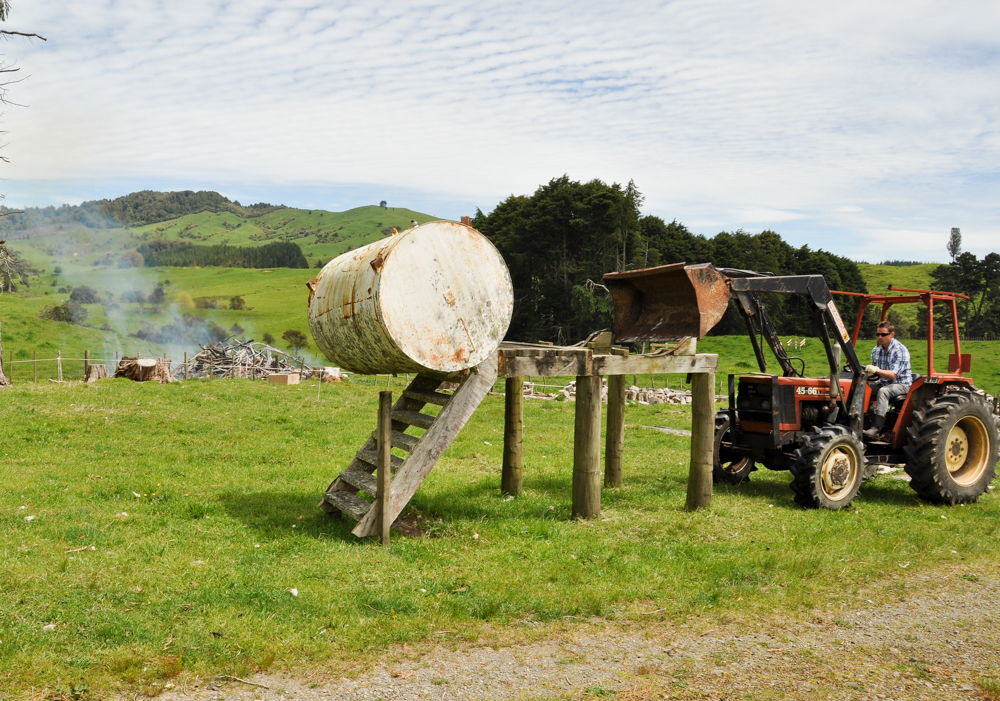
Back in November of last year we dismantled this manky old diesel tank platform. Situated next to the driveway, it was a bit of an eyesore from the cottage, and didn’t serve us any purpose. It was probably installed back in the day for the convenience of having plenty of fuel on tap for a hard-working tractor. We don’t use our tractor often enough to warrant the tank being there, and by the looks of the thing and its rusted hose, neither did the previous owner for some time.

We had set fire to our large burn pile earlier that same day and needed to stick around to keep a close watch, in case some wayward embers found their way to our hay barn or the surrounding grass caught. In addition to having a couple of helping hands with us on the day, it was a perfect opportunity to demolish this particular eyesore, which had been on our list to deconstruct for a while. Kind of ironically, this was a job for the tractor.

Firstly we needed to roll the tank off the platform, but the handrail was in the way. I was itching to use my new crowbar, so I eagerly took to it with testosterone-fuelled mania.

Who doesn’t love smashing things to pieces? Very therapeutic.

We took the hose off, then I banged out the tank supports on the side we wanted it to roll down. Conveniently, the ground was slightly inclined on that side (so the tank wouldn’t roll away) and the stairs would act as a ramp to break the tank’s fall.

Firing up the tractor, I gave the then free tank a wee nudge with the bucket.

Textbook, baby. Here’s the video:

Next up was changing out the bucket for the forks so I could attack the platform. First I tried lifting the main supports…

But they wouldn’t budge. So I drove around and stabbed the forks into the stairs.

And heave!

Yeehaw! I went back around for another shot at the supports, which weren’t connected by the stairs anymore.

Annnd…

Success! I love how there’s a little amused chuckle from cameraman Dingus at the end of all three videos.

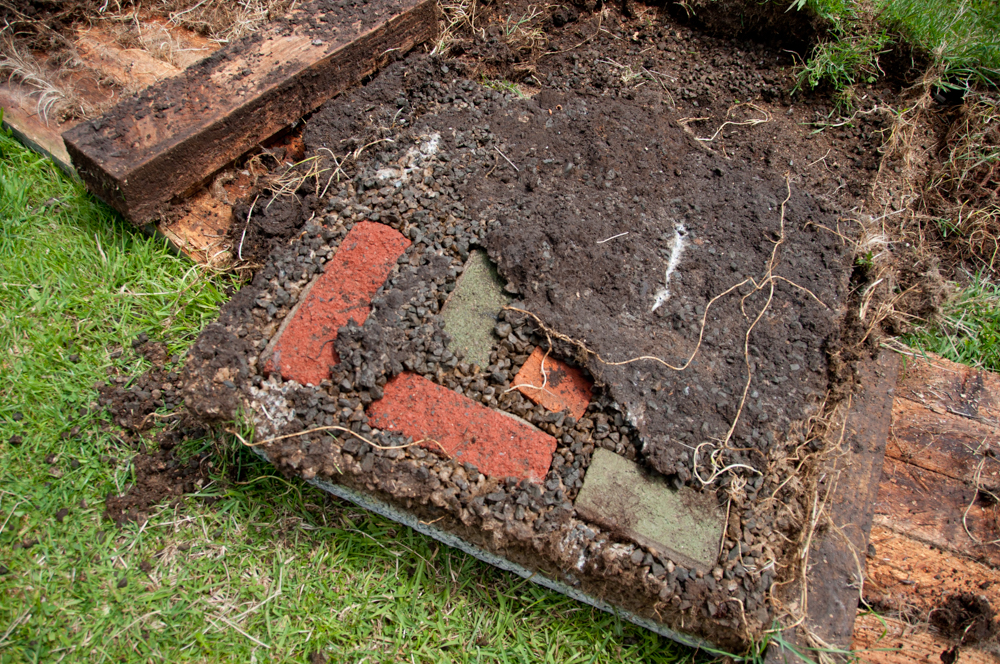
Dingus and I spent a good while dismantling the wood and storing it to be used again for some future project. James and Char discovered yet another pile of buried trash where the platform had been, so yanked out inordinate amounts of twine for the next half hour.

We’re slowly coming to the realisation that old farmers tend to use garbage as fill. Fine, I guess, if you never intend on digging it up again.

Meanwhile, Dingus is as Dingus does:

All right, all right, his photoshoot might have been my idea…

While we were in a destructive mood, we decided to pry up an old mill platform that we kept tripping over in the grass.

And the hefty concrete slab where an old saw would have perhaps stood.

I would later come back and smash up this bad boy with a sledge hammer and dismantle the rotten wood so we could burn it without leaving nails in our paddock.

Lastly, Dingus and James rolled the heavy tank onto the tractor forks, which I transported next to the barn for storage.

We like to keep any farm-related doodads that are salvageable – we never know how they might serve us in the future. I can imagine this particular piece of salvage would make a good rainwater tank in the garden, or it might even hold fuel again someday (biofuel?).

In any case, another eyesore bites the dust! Thanks for the help, Dingus and James!